Showing posts with label Love's Labor's Lost. Show all posts
Reflecting On Our Class Event
Reflection.. Reflection....
I have a hard time summing up events like Friday's. I just can't seem to get what I think into the right words. Yet, here goes nothing. Our Engaging Shakespeare event was easily the most fun I have ever had with a class project, and I feel like I have gained so much from the event itself and everything leading up to it. I was also really impressed with the projects from the other groups. I guess I can talk about each of those for a bit.
First off, I thought the event planning group did a fantastic job of getting everything organized and promoting our event and our class. They found a perfect room (I loved our stage!) and I was really impressed with the website that was put together and how smoothly J.J. and Austin ran everything that night. I am anxious for all the final products to be online!
The art group did a great job with their display, everything was organized really well and I could see that people enjoyed looking at their artwork. I was impressed by the number of pieces of art they were able to create in such a short time, and they were all really good quality! Their idea of each making lesson plans and then swapping and doing each others' was neat, too, because it's more authentic making sure someone else can understand and interpret where your lesson plan is trying to lead them.
I really enjoyed the sound effects and different voices that the audio group used in their rendition of Hamlet. The "(Character Name) Dies" parts are comical to read in the scripts, but it's even more entertaining in audio form. Although I think some groaning and dying noises would have been fun. I didn't get a chance to ask them at the show, but I'm curious about how they decided what lines to cut and what to keep. I'm interested to maybe listen to the whole thing and find out how much the theme or tone of the play has changed compared to other productions just based on what lines they kept and cut out.
I was impressed with the number of plays that the music video group was able to incorporate into their project and how seamlessly all of those plays fit together. I completely agreed with the point that Kara made about how Shakespeare is so much more than love stories, and the things he talks about are real and still apply to us today.
Now I might be a little bit biased, but the documentary was amazing! It was so well done. There's really not much else to say besides that they did a great job. Although if they had stuck around our rehearsals a bit more they would have caught a ton more hilarious things on film. But maybe it's good that things worked out the way they did... Anyway, what I payed attention to of the documentary as I was trying to forget how nervous I was about going up on stage, was fabulous.
And now, for my project! Lover's of Shakespeare! I am so glad that I chose the group that I did. We put so much hard work into our mini-play, and it was all worth it. It's so neat for me to be able to look back at how all the pieces fell together and we ended up with our final product. I never realized just how much effort and creative energy goes into doing something like that. Every single person in our group had so much to contribute. And it made me so happy every time the audience laughed at some little joke or line that was my idea, even if I wasn't the one delivering it. Even though I was the youngest in our group and probably had the least experience, I learned just how much I had to give when Romeo died by 5 Hour Energy Drink, Hamlet got his hat thrown at him, Ophelia exited with a splash, and I entered via boat. Unfortunately Juliet objected to death by lightsaber.. I guess what I'm saying is that I have always somewhat undervalued myself. But in this it was very easy for me to see just how much I did contribute along the way, and it was really wonderful to have a group who took my ideas seriously. I feel like I have grown a lot, as a Shakespeare student and as a person, through just doing things the way Shakespeare wanted and putting on a show.

Meeting the Learning Outcomes
I'm almost positive that our final project fits into all of the learning outcomes, but I'll try to include some other examples as well.
Since writing the midterm post, my Shakespeare literacy has continued to increase. We read King Lear, which was another first time read for me this semester. I watched the 2010 movie version of The Tempest (which I didn't much care for, so decided against posting about) and also re watched the Kenneth Branaugh adaptation of Hamlet on my own. Seeing Hamlet after reading it again and being in the middle of my project group's different interpretation of it was a neat experience.
I have also gained depth in my Shakespeare literacy through Analyzing Shakespeare Critically. Woo! I had a lot of analytical posts before the midterm interview and continued that by finding motifs and imagery in King Lear. I also took what I have learned through analyzing Shakespeare productions and applied it to a different genre when I posted about the Savior of the World production I went to over Thanksgiving break.
Engaging Shakespeare Creatively took up a large majority of my time dedicated to this class. Which is great! Before this semester I never would have thought that I could pull from, condense, and add to one of Shakespeare's plays to make a 5 minute script that still made sense. Before this semester I had never memorized a single line of Shakespeare, now I have my part of a 15 minute play memorized, and I ended up accidentally memorizing most of Gabe's lines, too! I got to act Shakespeare on stage and on camera(through the documentary). It has been such a good experience for me and I have grown so much closer to Shakespeare's works through my personal interaction with them.
I also got to Share Shakespeare Meaningfully because I engaged it creatively. Just as it happened with the Grassroots Shakespeare Company version of Macbeth, my excitement and enthusiasm for what I was involved in got the people around me interested in what I was doing. Except this time it was even more meaningful to me because I wasn't getting my roommate excited about a production of Macbeth someone else did, but I was sharing with my friends my excitement for something I was personally involved in creating. I would regularly come home from play rehearsals and tell my roommates about some crazy new gag we came up with, or rant to my best friend about how much fun I was having. So it was that much more meaningful when each of my friends who came to the event told me how much they liked our play (or at least, that's what they said!). I am sure that this will event will become a bond between those who experiences it, and I am so glad to have been able to associate Shakespeare with a fun and entertainment, as well as give it meaning, and hopefully I have impacted the people around me's opinion of Shakespeare for the better.

As a last note, in the midterm interview the two things that I needed to work on were self directed learning and some more concise posting. Excluding this post of course, I did make an effort to keep some of my thoughts more concise and organized. I also tried to self-direct my learning by revisiting old topics and focusing on things that interested me throughout multiple plays. One of those was animal imagery, which I first posted about with The Merchant of Venice, and later revisited with the monster motif and predator comparisons in King Lear. I also followed up on a post I had done with Winter's Tale about Greek Mythology (specifically Oedipus) when I drew comparisons between King Lear and the same topic.

So there you have it. The end of another semester. Brother Burton, I would just like you to know that this has been by far my favorite class this semester. I have truly enjoyed it. Thank you for pushing us to learn on our own terms and helping me take my Shakespearean education into my own control. I'll miss this class.

And now, to end this blog the only acceptable way it could be done,
Hakuna Mutata. It means no worries.
-Martina
As we're getting into The Tempest, there is a storm and a shipwreck and there are at least three separate groups (that I know of so far) that are stranded on the island. It seems odd to me that the very first thing someone in each group did was assume that everyone else was dead, and then look to see what they could gain from the situation.

Commonality of wrecking a ship
"Every day some sailor's wife, the masters of some merchant, and the merchant have just our theme of woe. But for the miracle-I mean our preservation-few in millions can speak like us." -Gonzalo
This quote suggests to me that shipwreck, and death and loss resulting from shipwreck, was very common in Shakespeare's day. In a brief history of Bermuda, there are four historic shipwrecks documented from 1500-1699. Which means there were many more that were not written about, obvious from the map here. So it seems like the characters of The Tempest were somewhat justified in thinking that anyone not with them must have perished. But there does seem to be some other reason why many of them gave up hope so quickly.


Let's all assume everyone's dead
Ferdinand: 
"The ditty doth remember my drowned father."
Alonso:
"My son is lost."
Sebastian:
"Milan and Naples have more widows in them of this business' making than we bring men to comfort them."
Antonio:
"'Tis as impossible that he's undrowned as he that sleeps here swims"
Trinculo:
"I should know that voice. It should be-but he is drowned, and these are devils."


What do we stand to gain?
Ferdinand:
"I am the best (highest ranking) of them that speak this speech (Italian)."
Ferdinand assumes the king, his father, is dead. And therefore assumes that he is now king.
Gonzalo:
"Had I plantation of this isle... and were the king on 't... I would with such perfection govern, sir, to excel the Golden Age."
Antonio (to Sebastian):
"My strong imagination sees a crown dropping upon thy head."
Sebastian (to Antonio): 
"As thou got'st Milan, I'll come by Naples. Draw thy sword. One stroke shall free the from the tribute which thou payest, and I the King shall love thee."
If the king, his son, and any witnesses are dead, Sebastian becomes king and Antonio gains his love and freedom from tribute.
Stephano:
"Trinculo, the King and all our company else being drowned, we will inherit here."
This quote pretty much sums up all the others. Stephano, a butler, believes that everyone higher ranking than him is dead, and plans on inheriting what would otherwise go to men above him.
The coat of the King of Naples.
 (What all these men were after)


Can't get any higher than the top
It's interesting to note that, though he believes his son to be dead at first, the king, Alonso, eventually finds hope and goes out to "search for [his] poor son." He is the only character who doesn't have anything to gain from the death of another. Since Alonso is already king, no one else's death would be beneficial to him, so he hopes his son lives. All the other characters have something to gain from the death of others, and so give up hope much more quickly. Sebastian and Antonio even go so far as to try and kill the King and Gonzalo so that they can be in higher positions of power when they return home. I'm sensing some Macbeth parallels here...


If I only had a brain.. or a conscience.
The case of Antonio and Sebastian stands out from the others. While all the other ambitions of characters rely on fortune, or misfortune, granting them the death of a superior, Antonio and Sebastian's ambitions must be taken by force. It is easy to justify taking power when the men before you were killed by nature, but it should not be so easy to justify killing for gain. Shakespeare's characters, however, seem to be burdened very little by their consciences. When speaking of murder Sebastian asks, "But for your conscience?" To which Antonio basically replies, 'I haven't got one. Nothing bothers me.' His justifications for the murder of the king are reminiscent of Berowne of Love's Labour's Lost justifying his pursuit of women. If they can put enough words together, then they can justify their actions to themselves. Sebastian's conscience seems to be won over, as he replies, "Thy case, dear friend, shall be my precedent." So these two men, who seemed so lighthearted and upright, justify murder and treason in less than five minutes.


Is Shakespeare's comment here that ambition is more powerful than moral conscience? That man will kill to get gain? And that those who don't bring themselves to murder are just as ready to accept the death of another if it benefits them? If so, who's death do you stand to gain from? Ever thought about it?
Just as a side note, I'm writing this post Thursday night and setting it to post tomorrow morning in order to blog on time for this week, in hopes that I can get some sleep and get better before I get more sick. Also, the BBC production of my individual play has to pause every 2 minutes to buffer and I will never get through it tonight.. But I do promise I'll still have my individual play finished and a post about it by the end of the day Friday. Cross my heart, hope to die.


Now you may or may not be aware, but there may or may not have been a sequel to Love's Labour's Lost... It would be fitting. The final act ended pretty lamely. The whole love story aspect of it kind of failed, and there wasn't even a real fight between Armado and Costard over Jacquenette. The Princess' father's death reminded me of the Greek deus ex machina, which was essentially some outside source swooping in to save the day when it looks like the plot won't be able to resolve itself. Because no audience would be okay with girls who made fools of the boys all pairing up with hecklers and living happily ever after, there had to be some good reason for the french ladies to go their way, leaving the men with a year to put their nose in the corner and think about what they've done.

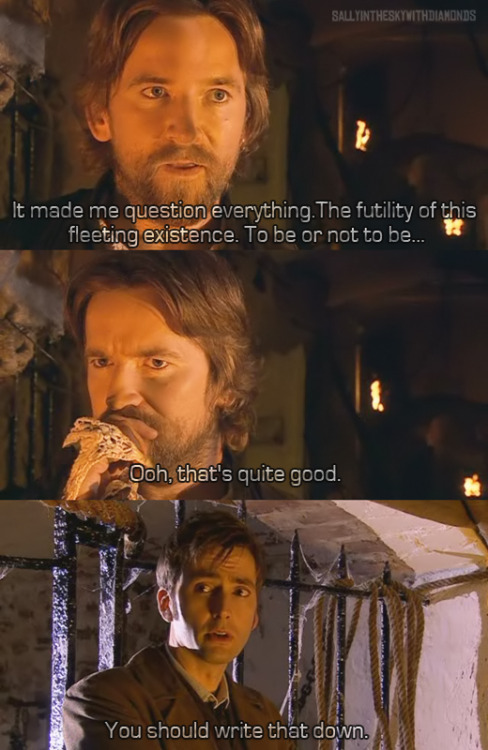
So the question is, was Shakespeare okay with this unresolved ending? Or did he write a sequel which somehow didn't survive the years? I first came across the theory of there being a sequel in an episode of Doctor Who. The time-traveling humanoid alien takes his human companion Martha Jones back to Shakespeare's day at the Globe Theatre. At the end of a Love's Labour's Lost performance William himself takes the stage and promises a sequel the very next day. Somewhere along the way he hits on Martha, someone gets killed via voodoo doll, and an alien in the form of a witch tampers with the script of the sequel in an attempt to, go figure, free her alien family and take over the world. You can read more about it here, but the point is that at the end the only transcript of the Love's Labour's Won is lost and Shakespeare decides to move on to bigger and better things.

I remembered that episode of Doctor Who as I was reading Love's Labour's Lost and decided to see if BBC did their research. It turns out, there is a very good possibility that there WAS a sequel, titled Love's Labour's Won, in which the King and his lords return after a year and get a second chance at a happy ending with the French Princess and her ladies. There have been references to the play title found in written documents, and lots of other reasons for scholars to believe in the existence of the play that I don't really want to get into here. You can read the wiki page linked above if you're interested. Also, there's a facebook page, so it must be true. Facebook never lies. The real question is, do you think the plot needs a sequel? I do.. And if there was a sequel, what kinds of themes or plot lines would you like to have been continued? Should there be a happy ending between the sassy ladies and immature boys? I'd love to hear your thoughts.
Last Friday my roommate had a boy over at our apartment and they were doing homework together. He started humming a song I vaguely recognized but couldn't quite place. Of course, I couldn't rest until I figured out what it was. Turn's out it was the song "When You Believe" from The Prince of Egypt. So of course that dang boy got the song stuck in my head and I had to go listen to it. Then I had to listen to it again, and again, and again. Needless to say, I've been listening to the Moses and the Hebrews leave Egypt since last Friday. I ended up finding an awesome video with the song put to a compilation of the movie. As I watched this video again and again (and was overheard singing it in the shower), I started thinking about the power of song, and how a well acted (or animated) scene and a good song can elicit emotions from us and make an experience more memorable. As you watch this video, pay attention to how it makes you feel, and maybe consider how different it would be if you were simply reading the words.

It's also pretty cool in context...

So why in the the world am I talking about this on my Shakespeare blog? Well, I've been thinking as I read Love's Labour's Lost about the production of Winter's Tale we went to and the fact that Shakespeare is meant to be seen, not read. That play was so different on stage than it was in my book. I was more connected to the characters, more invested in the plot, and better able to understand the humor. And the songs were awesome. There's a line in the beginning of Act 3 of Love's Labour's Lost that says:

BOY[sings] Concolinel


My footnote says that the word "Concolinel" is unknown, but is perhaps the first word or title of a song. So you're probably saying "so what?". Well, I don't know. I can't know, because all it is, is a word, not even lyrics to a song. What if the song sung by that boy is something as important to the plot as the song above was to its movie? Shakespeare wrote this boy to sing a song and I will never know what it sounded like. What else are we missing out on by simply reading the text? Moses's animated sister and wife singing about their faith in miracles had a real impact on me, now this boy singing Concolinel will never have the chance to do that.

So, answer me this: What are we missing out on when we only read the text of Shakespeare's plays? And, conversely, what are we gaining from experiencing the greatest literature of all time in a way it was not meant to be experienced?
As we are reading Love's Labor's Lost, it's almost comical (probably intentionally) how quickly the king and his three lords start to deviate from their plan to study and see no women for 3 years. Before they've even signed the agreement the king realizes he must meet with a princess soon. And once the king and his lords reach the princess and her ladies all hope is lost. Flirting ensues.

The conversations that go on between the men and women in Act 2 are quick and witty. They remind me a lot of the kind of talk in Much Ado About Nothing that goes on between Benedick and Beatrice. And since we know that Benedick and Beatrice end up together, even though they originally seemed to hate each other, it is pretty obvious what is going on here in Love's Labor's Lost:

Biron. Did not I dance with you in Brabant once?
Rosaline. Did not I dance with you in Brabant once?
Biron. I know you did. 605
Rosaline. How needless was it then to ask the question!
Biron. You must not be so quick.
Rosaline. 'Tis 'long of you that spur me with such questions.
Biron. Your wit's too hot, it speeds too fast, 'twill tire.
Rosaline. Not till it leave the rider in the mire. 610
Biron. What time o' day?
Rosaline. The hour that fools should ask.
Biron. Now fair befall your mask!
Rosaline. Fair fall the face it covers!
Biron. And send you many lovers! 615
Rosaline. Amen, so you be none.
Biron. Nay, then will I be gone.

Biron tries to be nice, Rosaline's a little fiesty, but by the end of their back and forth they've fallen into rhyme with each other. I can hear the wedding bells already.. Shakespeare is awesome at witty banter. It's one of the things that make his comedies funny, and his romances bearable. This art of witty banter seems to be Shakespeare's opinion of the best way to find your eternal companion. Lucky for us it can be mastered in just ten easy steps. Enjoy. But maybe don't try it out on the first date... Just in case.
Back on track, it seems to me like there is a pretty standard form of humor in Shakespeare's comedies. It's either love at first sight, or witty banter and insults until they realize they're meant to be together. Maybe Love's Labor's Lost's king and his lords with mix things up a bit for us. But so far I'm doubtful.. To illustrate, even taking into account that the movies below are both Kenneth Branagh films, the covers might as well be advertising the same play with different actors. Plus or minus a perfectly matched and awkwardly close couple. I'm anxious to see what makes this play different from others.